China's AI Stock Crash: $2.4 Trillion Vanishes Amid US Rivalry
The STAR 50 Index has fallen 40% since June as weak domestic demand and US export bans erode confidence in China's tech sector.
By Carlos Rivera ·
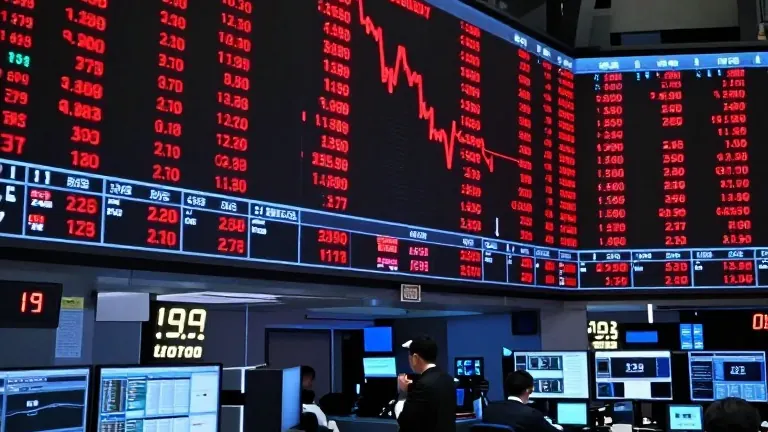
Chinese stock markets have lost 2.4 trillion dollars in value since May, a drop driven by growing anxiety over the country's ability to sustain its artificial intelligence boom. The decline reflects a widening gap between Beijing's aggressive investment in technology and the reality of a domestic economy where consumers are spending less than expected.
The damage is concentrated in the tech sector. The STAR 50 Index, which tracks technology and innovation firms on the Shanghai exchange, has plunged 40% since June. Other major indices for large companies fell by approximately 20% over the same period. According to Goldman Sachs, AI stocks represent more than 40% of the total market value in China and Hong Kong, meaning that declines in this sector ripple through the entire domestic market.
Beijing has attempted to shore up the industry with substantial state backing. The government launched a 60 billion yuan state-backed AI investment fund that began distributing capital to domestic developers this month. However, these efforts have struggled to offset the reluctance of Chinese consumers to spend. This hesitation prevents many tech companies from generating sufficient profits, a problem that has fueled the recent sell-off.
External pressures from the United States have compounded the domestic challenges. Washington has banned Chinese humanoid robots, citing national security risks, and is considering restrictions on Chinese components in data centers. These measures hurt Chinese companies that rely heavily on exports. When they cannot sell abroad, they face a domestic market that lacks the buying power to absorb the excess inventory.
Dan Wang, the China director for the Eurasia Group, described the current climate as one of "general anxiety" among technology firms. She noted that this year's profit margins have not met expectations, while US interest rates remain elevated and domestic demand stays weak. Wang questioned whether the state-backed model can function effectively when consumers are not purchasing the products.
The robotics sector, a key pillar of China's AI strategy, has suffered particularly heavily. Beijing views embodied AI as the solution to demographic issues like an aging population and a shrinking workforce. Yet, demand is currently driven by government agencies and research institutions rather than households. Products like humanoid robots and robotic dogs remain too expensive and impractical for everyday home use. Shares in Unitree, a leading Chinese robot maker, have halved since the company began trading in August.
Wang stated that it does not look like embodied intelligence will translate into mass market profits in the near term. She pointed to thin margins, rising US rates, and weak domestic demand as the primary factors driving investor fear. While optimism persists in other areas like AI research and satellites, the lack of a clear path to profitability for consumer tech has left investors wary.
Policy makers face a difficult timing issue. China has restricted overseas investment in recent months, with new regulations taking effect on December 1, to encourage domestic spending. Despite this, investors have not flocked back to Chinese markets. Stimulus measures are being held back because top party officials are gathering this week for the fifth plenum. This meeting will set the stage for next year's 21st Party Congress, where Xi Jinping is expected to secure a fourth term as leader.
Wang described any new stimulus as "high risk" in the current political climate. She warned that if a policy fails to boost the economy, the officials who proposed it would face accountability. With no appetite for destabilizing moves before the Congress, policymakers are likely to maintain the status quo despite the pressure to support the struggling tech sector.
The global AI boom is expected to continue for at least another year, but China's domestic market is facing a distinct headwind. On Monday, US company Anthropic filed for an initial public offering that could raise up to 100 billion dollars. In contrast, China has no comparable blockbuster IPOs scheduled, leaving its market to contend with the current decline without a major new source of liquidity.
Source: The Guardian